v0.4 · early access//self-hosted
Every trip your dashcam recorded, indexed and searchable.
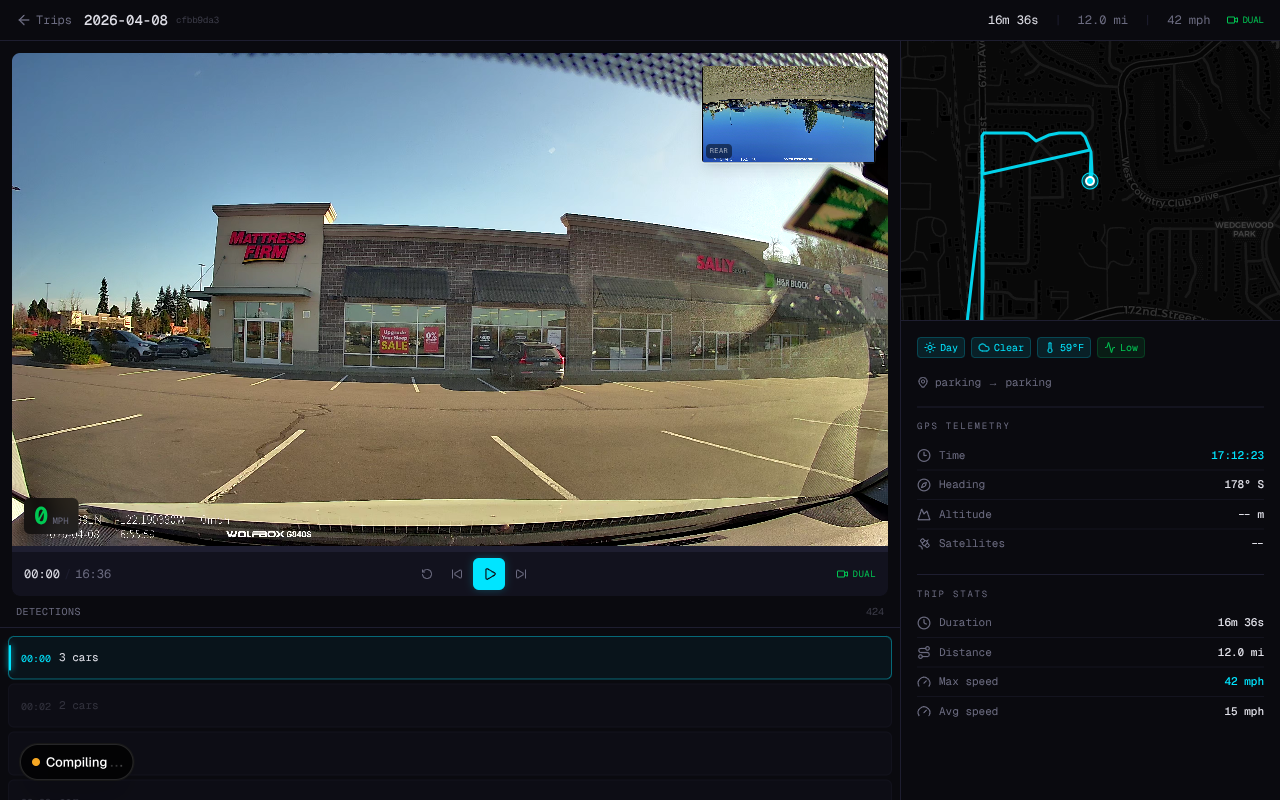
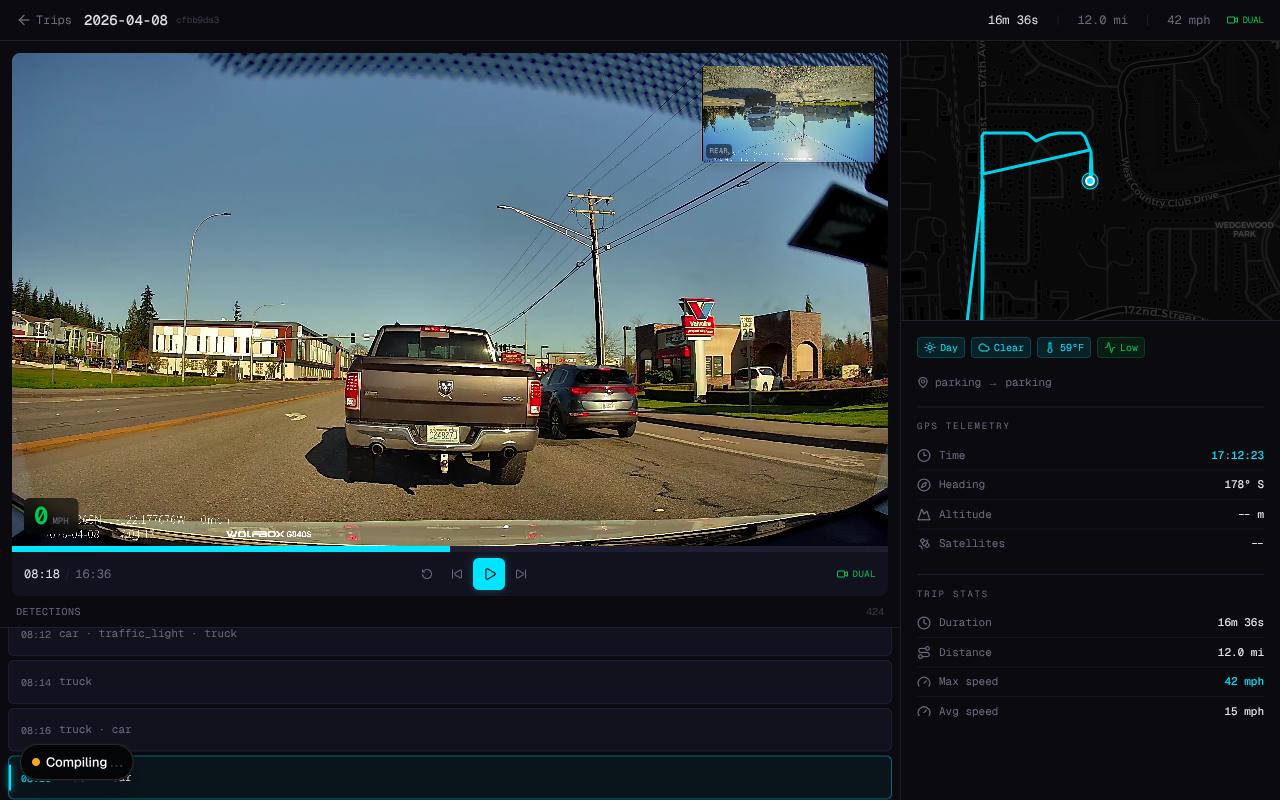
Darkdash runs on your hardware. Point it at your dashcam footage and it builds a private, ML-analyzed archive of every drive — frame by frame, vehicle by vehicle, scene by scene.
No spam. One launch email. Double opt-in. Read the install plan.
// what it does
Eight things on the same box.
No cloud, no subscriptions, no telemetry. Drop the binary on the same server that runs your Plex, point it at your dashcam SD card, and walk away.
- 01
Trip detection
Raw clips become coherent trips. Gaps, idles, and parking events are stitched into a single timeline you can scrub.
- 02
Frame-by-frame ML
Object detection on every other frame. Vehicles, people, signs, lights, animals — labeled, timestamped, indexed.
- 03
Scene summarisation
An optional VLM pass writes a one-line description of every scene. Searchable. "that time a deer crossed in front of me on the 99."
- 04
GPS & telemetry
Speed, heading, altitude, satellite count, weather — all parsed from the embedded MP4 metadata. Mapped, charted, queryable.
- 05
Event extraction
Hard braking, sudden lane changes, emergency vehicles in frame — flagged automatically. Skip 49 minutes of nothing to the 8 seconds that mattered.
- 06
Front + rear, in sync
Dual-channel cameras are time-aligned and detected in parallel. The view from behind matters too.
- 07
Maps & route replay
The GPS track drawn on a real map. Scrub the route, watch speed and heading move with the footage, jump to any point on the drive.
- 08
Portable .darkdash bundles
Every trip is a self-contained bundle — manifest, detections, video, keyframes — served over a plain REST API. your data, your format.
// your data stays local
It runs where your footage lives.
And nowhere else.
Darkdash is a single binary plus a Postgres instance you already had lying around. Footage never leaves the network it landed on. The ML models are local — ONNX for detection, llama.cpp for the VLM pass.
- No outbound calls. No telemetry. verified by
tcpdump. - No license servers. AGPL, in perpetuity.
- Your number plates aren't a training set for anyone.
- Bring-your-own model weights for the VLM.
// frequently asked
The honest answers.
Is it ready?
No. Darkdash is v0.4 — alpha-quality. Trip detection, frame-level ML, dual-camera sync, and the trip viewer work. The VLM scene-summary pass is gated behind a flag and slow on CPU. Auth is bare. Hardware support outside the Wolfbox G840S is unverified. If you want the polished version, the waitlist is the right call.
Which dashcams work?
Anything that writes MP4 with embedded GPS metadata. The Wolfbox G840S is the daily-driver test rig. Viofo, Vantrue, BlackVue, and Garmin formats are parsed but not all metadata fields are extracted yet. If your camera dumps a directory of timestamped MP4s, you can ingest it.
How much hardware?
A Pi 5 with an SSD can ingest a day's footage overnight (CPU only). A box with a 3060 chews through a week in an evening. The VLM pass is where the GPU earns its keep — without one, you'll want to leave it off or run it on a subset of flagged scenes only.
Will it phone home?
No. The binary makes zero outbound HTTP calls. There is no update check, no error reporting, no analytics. If you want updates, you git pull and rebuild. If you want a status page, you set one up.
License?
AGPL-3.0. Fork it, run it, modify it for personal use freely. If you host a version for other people, your version is AGPL too.
When does the waitlist open?
You're on it the moment you confirm the email. There's no queue and no invite codes — the email goes out the day the v1.0 tag lands. Realistically: late 2026.